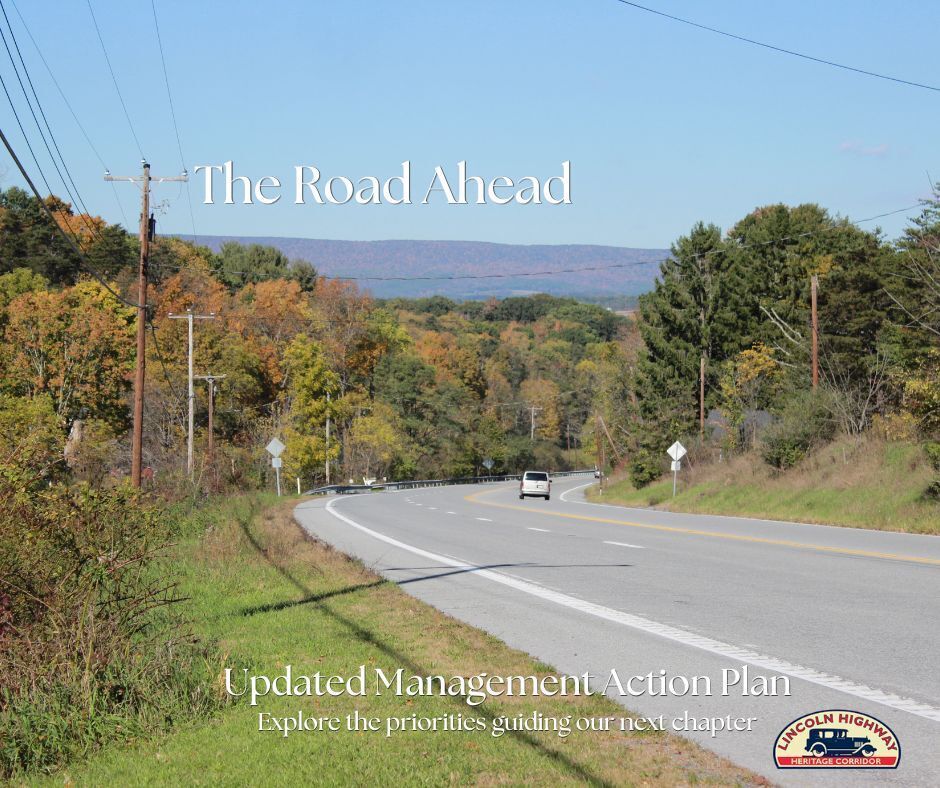
Discover the priorities, partnerships, and projects guiding the Lincoln Highway Heritage Corridor through its next chapter.
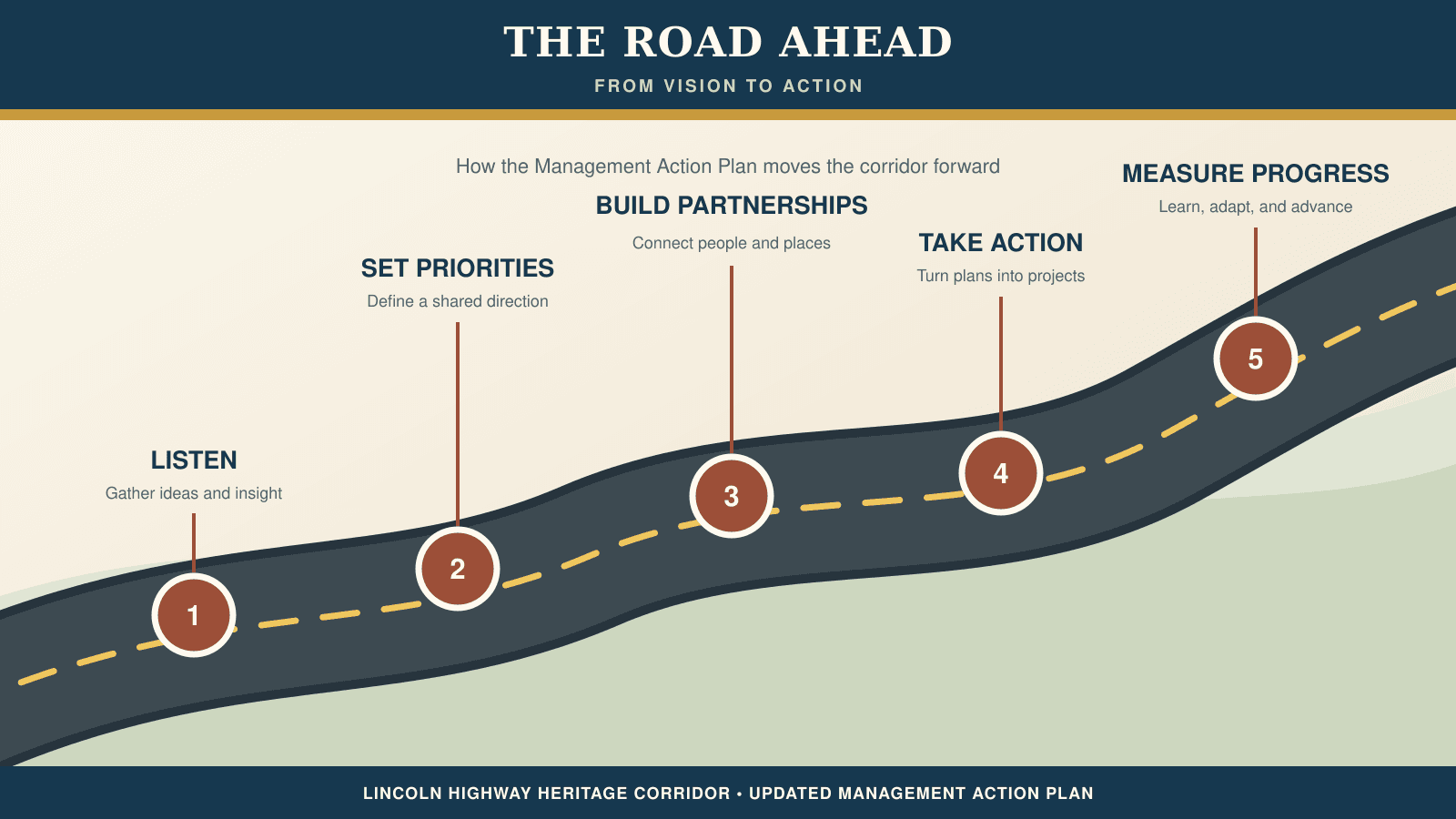
The Road Ahead: Initiatives from the Updated Management Action Plan
The Lincoln Highway Heritage Corridor’s updated Management Action Plan provides a framework for building a more active, visible, connected, and sustainable Corridor. It reflects an evolving vision for how LHHC can serve its communities, welcome travelers, share a broader range of stories, and protect the resources that make Pennsylvania’s Lincoln Highway distinctive.
The initiatives below represent important directions identified in the plan. Some build upon work already underway, while others offer longer-term opportunities that will depend upon partnerships, funding, organizational capacity, and continued community involvement.
Creating More Ways to Explore
The plan envisions new opportunities for visitors to experience the Lincoln Highway and the communities surrounding it.
- Create themed itineraries and driving experiences centered on military history, parks and recreation, heritage sites, and other interests. These routes can encourage travelers to spend more time exploring the Corridor and discovering places beyond its best-known attractions.
- Make it easier for museum visitors to continue their journey along the Corridor. Driving guides, itineraries, partner promotions, discounts, and other tools can establish the Lincoln Highway Experience as a starting point for further exploration.
- Connect history with outdoor recreation by highlighting places to hike, bike, fish, explore parks and forests, experience dark skies, and travel historic Lincoln Highway alignments. These experiences can also promote conservation and responsible stewardship.
- Experiment with new events and experiences, including smaller programs that attract new audiences, generate revenue, and may eventually be replicated with partners elsewhere along the Lincoln Highway.
Sharing More Stories in More Places
Expanding interpretation beyond the Lincoln Highway Experience is another important part of the plan’s vision.
- Take Lincoln Highway stories on the road through mobile exhibits, traveling programs, lectures, and activities hosted at locations throughout the Corridor.
- Develop stronger interpretive hubs in selected communities and regions. These hubs could concentrate partnerships, signage, events, promotional materials, and storytelling to create recognizable points of connection along the route.
- Improve wayfinding and interpretation by evaluating, maintaining, updating, and expanding signs, interpretive panels, murals, and other Corridor assets.
- Tell a broader Lincoln Highway story that connects the familiar nostalgia of early automobile travel with the highway’s lived experience today. Future interpretation will seek to incorporate more of the people, places, communities, and perspectives that have shaped—and continue to shape—the road.
Building a More Connected Corridor
The Lincoln Highway is not experienced through one destination alone. Strong collaboration will be essential to creating a journey that feels connected across communities and county lines.
- Build stronger partnerships with parks, conservation organizations, museums, schools, tourism bureaus, municipalities, restaurants, lodging properties, small businesses, and other attractions.
- Strengthen LHHC’s identity throughout the entire Corridor through consistent branding, storytelling, digital engagement, media partnerships, visitor-generated content, and collaborative promotion. The goal is to help LHHC grow from an organization associated with a “known road” into a recognized organization serving that road and its communities.
- Expand LHHC’s digital resources through a more capable website and, eventually, a digital directory connecting travelers with attractions, organizations, businesses, recreation, and other resources along the Lincoln Highway.
Supporting Learning and Community Projects
Education and community investment will remain central to LHHC’s work.
- Grow educational opportunities for students and lifelong learners by working with schools, colleges, museums, historic sites, guest speakers, interns, and other partners to introduce Lincoln Highway history to new audiences.
- Establish the Mini Grant Program as a consistent annual resource supporting preservation, conservation, recreation, education, and community projects. Workshops and technical assistance can further help Corridor organizations develop strong, sustainable initiatives.
Strengthening the Organization Behind the Mission
Achieving the plan’s vision will require the financial resources, professional capacity, and infrastructure needed to sustain the work over time.
- Grow and diversify financial support through public and private grants, sponsorships, individual and corporate giving, earned revenue, rentals, annual giving, planned giving, and the eventual exploration of an endowment.
- Invest in the people and infrastructure behind the mission. Priorities include staff professional development, future staffing needs, Board development, organizational policies, technology, preventative maintenance, and the long-term care of the Lincoln Highway Experience.
Exploring the Corridor’s Eastern Future
The plan also considers the Lincoln Highway Heritage Corridor’s potential expansion into York and Lancaster counties. Before any formal expansion, LHHC will focus on strengthening its presence in Franklin and Adams counties, developing relationships throughout the eastern Corridor, and testing collaborative programs with prospective partners.
Together, these initiatives provide a flexible roadmap for the years ahead. Through thoughtful interpretation, stronger partnerships, meaningful visitor experiences, community investment, and responsible organizational growth, LHHC can continue connecting people with the stories and places of Pennsylvania’s Lincoln Highway—while preparing the Corridor for its next chapter.